Scorpio season 2026 runs from October 23 to November 22, and this year it is one of the most intense, inward-turning stretches of the entire astrological calendar. Mercury goes retrograde in Scorpio the day after the season opens. Venus is already retrograde. And the whole month is wrapped in the thinning-veil energy of Halloween, Samhain and Día de los Muertos.
So let me say this to you the way a big sister would, with love and without sugarcoating it: this is not a season to perform. It is a season to get brutally honest.
People sometimes ask me why a lifestyle blog about home, style and wellness talks so much about the stars. The truth is simple. Astrology gave me a language for something I had always felt but couldn't name: life moves in seasons, and we are not meant to live every month the same way.
I'm a Capricorn, so I love a plan. For years, I tried to power through life on one steady setting. Same energy, same output, same expectations of myself, no matter what was happening around me or inside me. It worked until it didn't. What finally changed things wasn't working harder. It was learning to move with the rhythm instead of against it.
That's what living through the zodiac seasons intentionally gives you. Each season carries its own invitation. Aries asks you to begin. Cancer asks you to come home. Virgo asks you to tend the details. Scorpio asks you to go deep and let go. When you know what a season is asking of you, you stop fighting yourself. You rest when it's time to rest, push when it's time to push, and release when it's time to release, without guilt.
I've written a guide like this for every zodiac season for years now, and Scorpio is the one I always sit with a little longer. It's the season that taught me the most. Because I know what it feels like to stand in the middle of your life and realize the version of you that got you here cannot come with you where you're going. I know what it feels like to start over in your forties, to rebuild something from the ground up with your own two hands, and to discover that the ending you were most afraid of was actually the doorway.
That is Scorpio energy. It strips things down to what's real, and then it hands you the power to rebuild.
In this guide, we're going deeper than a list of crystals and candles. We'll talk about what Scorpio season actually feels like in your body and your relationships, what's happening in the sky in 2026, how the season shows up in nature and culture all around us, and what it's asking of us as women. Then I'll walk you through all of the things I do personally; shadow work, rituals, journal prompts, affirmations, feng shui, self-care, and what this season means for your sign.
Pour yourself something warm. Light a candle if you have one nearby. Let's go into the deep end together.
When Is Scorpio Season 2026? Dates and Key Cosmic Moments
Scorpio season 2026 begins on Friday, October 23, when the Sun enters Scorpio, and ends on Sunday, November 22, when the Sun moves into Sagittarius. What makes this year different is how crowded the sky is. The Sun, Mercury and Venus all share Scorpio at the start of the season, two planets are retrograde at once, and both of them turn direct on the very same day.
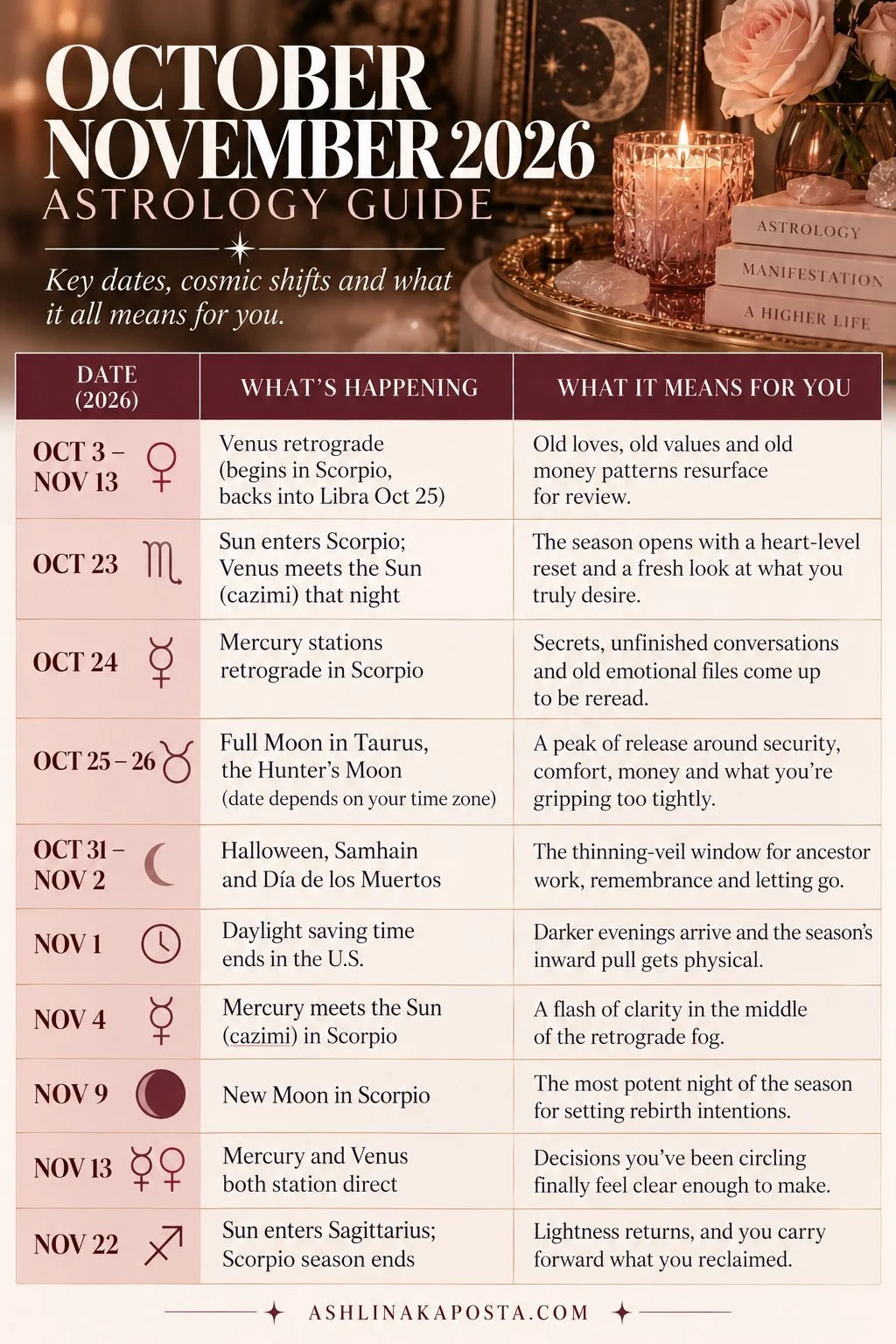
A note on the retrogrades: they are not a reason to fear this season. Think of them as the universe handing you a highlighter and saying, look again. Mercury retrograde in Scorpio stays in the same sign the entire time, so the review is concentrated. Whatever comes back to you between October 24 and November 13 is coming back on purpose.
What Scorpio Season Really Feels Like
Scorpio season feels like the moment the party ends and the real conversation begins. Libra season before it was about balance, beauty and harmony, about keeping the peace. Scorpio doesn't care about keeping the peace. It cares about the truth underneath the peace.
Scorpio is a fixed water sign, ruled traditionally by Mars and in modern astrology by Pluto, the planet of death, rebirth and power. Water is emotion. Fixed means it goes deep and stays. So this isn't the bubbling, changeable emotion of a Cancer moon or the dreamy flow of Pisces. This is the still, dark, bottomless lake. Calm on the surface, with everything you've ever felt resting at the bottom.
That's why so many women tell me they feel heavier in late October. More tired. More sensitive. Suddenly thinking about an ex they haven't thought about in years, or crying at a commercial, or noticing a resentment toward someone they love that they didn't know was there. You're not falling apart. You're being invited below the surface.
The three faces of Scorpio
Scorpio has long been described through three symbols, and I find they map beautifully onto how this season moves through us.
The Scorpion is the protective, defensive self. It's the part of you that stings first so you can't be hurt, that keeps score, that holds a grudge as armor. Early in the season, you may notice her showing up.
The Eagle is the part of you that rises above the wound and sees the whole picture. She understands why it happened and what it taught her. She chooses perspective over punishment.
The Phoenix is the woman who lets the old version of herself burn completely, and rises from the ashes as someone new. This is the highest expression of the season, and it's available to every single one of us.
The work of Scorpio season is moving from scorpion to phoenix. Not by skipping the pain, but by walking all the way through it.
The core themes of Scorpio season
If I had to distill this season into what it's really asking of you, it would be these:
Truth over comfort. Where are you pretending things are fine?
Intimacy over image. Who actually gets to see the real you?
Power over people-pleasing. Where have you handed your power to someone else's approval?
Release over control. What are you gripping because you're afraid of what happens if you let go?
Rebirth over repetition. Which patterns are you ready to finally lay to rest?
Scorpio is also the sign of shared resources, inheritance, sexuality, merging and money that flows between people. So don't be surprised if debts, joint finances, physical intimacy and trust come into focus too. All of it lives in the same deep water.
The Season Outside Your Window: Nature, Weather and Culture
One of the most grounding things you can do during Scorpio season is to look outside, because nature is doing exactly what you're being asked to do.
Nature lets things die on purpose
By late October, the trees have stopped clinging. The leaves that were glorious a few weeks ago are falling, browning and returning to the soil. Gardens are being cut back. Fields are harvested and left bare. None of this is failure. It's how the earth stores energy for the next spring.
The tree doesn't try to hold on to every leaf. It knows that what falls becomes nourishment for what grows next. That is the most beautiful lesson Scorpio season offers us as women: letting go is not losing. It's composting. Everything you release this month becomes fertile ground for who you're becoming.
The light leaves, and we turn inward
In the Northern Hemisphere, the days are shrinking fast. On November 1, daylight saving time ends in the U.S., and suddenly it's dark before dinner. Your body notices this even if your calendar doesn't. Many of us feel a natural pull to sleep more, eat warmer food, stay home and go quiet.
I want you to honor that pull instead of fighting it. Our culture tells women to be "on" all year long. But we are cyclical beings, and this is the evening of the year. Rest is not laziness right now. It's alignment.
The veil is thin
It is not a coincidence that Scorpio season holds Halloween, the ancient Celtic festival of Samhain, All Saints' and All Souls' Days, and Día de los Muertos. Across cultures and centuries, people have felt that this is the time of year when the boundary between the living and the dead grows thin.
We dress up as our shadows. We decorate with skeletons and candles. We build altars for the people we've lost. In our own playful, modern way, we are still doing what our ancestors did: acknowledging death so that we can live more fully.
This is the perfect window to honor your grandmothers and the women who came before you, to remember someone you've lost, and to grieve the things in your life that have ended, even the ones you chose to end.
The holiday rush is coming
There's one more cultural current worth naming. Scorpio season ends right before Thanksgiving and the full sprint into the holidays. Gatherings, family dynamics, travel and spending are all just around the corner.
Think of Scorpio season as your private preparation. The boundaries you set now, the emotional clean-up you do now, and the clarity you find now are what will carry you through December with grace instead of exhaustion.
you may also like:
Scorpio Season and the Feminine: What This Season Asks of Women
Scorpio is, in many ways, the most misunderstood feminine energy in the zodiac. We're taught that feminine means soft, sweet, agreeable and easy. Scorpio reminds us that the feminine is also fierce, magnetic, private, sensual and powerful. She's the woman who doesn't need to raise her voice because everyone in the room can already feel her.
Here's what I believe this season is asking of us.
Stop shrinking your intensity
So many of us were told we were "too much." Too emotional, too sensitive, too intense, too ambitious. And so we learned to dilute ourselves to keep everyone comfortable.
Scorpio season gives you permission to stop. Your depth is not a flaw. The way you feel things fully is the same capacity that lets you love fully, create fully and build a life that actually means something. You don't need to be less. You need to be in rooms and relationships that can hold all of you.
Reclaim your power, quietly
Scorpio power is not loud. It's not about winning arguments or proving anything. It's the steady, unshakable knowing of a woman who has decided what she will and will not accept.
This is the season to notice where you've handed your power away. To a partner's moods. To a boss's approval. To your mother's expectations. To an old story about what women like you are allowed to have. Then to gently, firmly take it back.
Let intimacy be real
Scorpio rules intimacy, and I don't just mean the physical kind (though that too). I mean the courage to let someone truly see you. The unfiltered version. The scared version. The version without the curated feed.
Many of us are excellent at being needed and terrible at being known. This season, practice being known. Tell one person a truth you've been holding. Let someone help you. Let love in at the level you've been giving it out.
Honor your sensuality
Scorpio is one of the most sensual signs of the zodiac, and this is a beautiful season to come home to your body. Not to fix it or shrink it, but to enjoy it. Wear the silk. Light the candle. Take the long bath. Put on the perfume that makes you feel like a secret. Your pleasure is not frivolous. It's part of your power.
Remember you can be reborn at any age
I want to say this especially to my sisters over 40. Scorpio season is proof that endings and beginnings are not reserved for your twenties. You can reinvent yourself at 42, 55, 68. You can leave the marriage, change the career, buy the house, start the business, heal the wound you thought you'd carry forever.
I know because I've done it. The phoenix doesn't check her age before she rises.
Shadow Work for Scorpio Season: Meeting the Parts of You That You've Hidden
Shadow work is the heart of Scorpio season. If you only do one thing from this guide, let it be this.
Your shadow is simply every part of yourself you learned to hide, deny or disown because at some point it didn't feel safe or acceptable. The anger you swallowed. The jealousy you're ashamed of. The ambition you were told was unladylike. The neediness you cover with independence. The grief you never had time for.
Those parts don't disappear when we hide them. They go underground and start running the show from the basement. They show up as overreactions, self-sabotage, patterns in relationships that we can't seem to break, and the strange feeling of being stuck even when life looks fine on paper.
Scorpio season brings the basement lights on. That can feel uncomfortable. But you cannot heal what you refuse to see.
How to tell your shadow is showing up
Watch for these signs this month:
You have a reaction that's much bigger than the situation called for.
Someone else's success, body, relationship or confidence stings more than you'd like to admit.
You keep attracting the same kind of partner, friend, boss or conflict.
You find yourself judging a quality in someone else very harshly.
An old memory, person or feeling keeps resurfacing for no obvious reason.
Every one of these is a breadcrumb. Your triggers are not your enemies. They are signposts pointing to the exact place where healing is waiting.
A simple shadow work practice for this season
You don't need to do this perfectly. You just need to be honest. Set aside 20 minutes, ideally in the evening when the house is quiet.
Name the trigger. Write down one moment this week when you felt a strong negative reaction. Be specific about what happened.
Feel it in your body. Close your eyes and recall the moment. Where do you feel it? Your chest, your stomach, your jaw? Just notice, without trying to fix it.
Ask what it's protecting. Ask yourself: what am I afraid this means about me? Often the answer is an old belief like "I'm not enough," "I'll be abandoned," or "I have to do everything myself."
Find the origin. When is the first time you remember feeling this way? Let a memory come, even if it seems small.
Speak to her with love. Write a few lines to the younger you who first learned this belief. Tell her what she needed to hear then.
Choose the new truth. Write one sentence that replaces the old belief. This becomes your affirmation for the week.
A gentle word from your big sister
Shadow work can bring up real pain. Go slowly. You don't have to excavate your whole life in one month. If something heavy surfaces, like old trauma or grief that feels too big to hold alone, please reach out to a therapist or counselor. Asking for support is not weakness. It's one of the most Scorpio things you can do, because it means letting someone into the deep water with you.
And remember: the goal of shadow work is not to become a perfect woman with no dark side. It's to become a whole woman who knows her darkness, loves herself anyway, and is no longer controlled by what she used to hide.
Rituals for Scorpio Season 2026
Rituals are how we turn intention into something we can feel. They don't need to be elaborate or expensive. What makes a ritual powerful is your presence, not your props. Here are six I've built around this year's specific cosmic moments.
1. The Hunter's Moon Release (Full Moon in Taurus, October 25–26)
The full moon is the season's first big exhale. Taurus rules security, comfort, money and the body, so this full moon asks: what are you holding on to because it feels safe, not because it feels right?
On the night of the full moon, write down three things you're ready to stop gripping. Maybe it's a job that's comfortable but draining, a spending habit that soothes you, or a relationship you're staying in out of fear of being alone. Read each one aloud, then safely burn the paper in a fireproof bowl or tear it up and bury it in the earth. As it goes, say: "I release what I've outgrown. I trust what's coming."
2. The Ancestor Altar (October 31 – November 2)
During the thinnest point of the veil, create a small altar to honor the women who came before you. Gather photos of your mother, grandmothers or great-grandmothers, or anyone you've loved and lost. Add a candle, a flower (marigolds are traditional for Día de los Muertos), and something they loved, like a favorite food, a perfume or a piece of jewelry.
Sit with them for a few minutes. Thank them for what they survived so you could be here. Then ask yourself honestly: which of their burdens am I still carrying that I'm allowed to set down? Some patterns end with you. That's not betrayal of your lineage. It's healing it.
3. The Mercury Retrograde Unsent Letter (October 24 – November 13)
Mercury retrograde in Scorpio is the perfect time to say everything you never said, without the risk of saying it to the wrong person at the wrong time.
Write a letter to someone you have unfinished business with. An ex, a parent, a friend who hurt you, or even your younger self. Don't edit or soften it. Write the anger, the hurt, the love, the questions. When you're done, read it aloud to yourself. Then burn it, shred it or keep it sealed until Mercury goes direct on November 13, and decide then whether anything in it truly needs to be said out loud. Usually, the release happens in the writing.
4. The Sacred Release Bath
Scorpio is a water sign, and water is one of the oldest tools for emotional cleansing. Run a warm bath and add a cup of Epsom salt, a handful of sea salt, and a few sprigs of fresh rosemary or eucalyptus. Dim the lights. Light a dark red or black candle.
As you soak, imagine everything heavy you've been carrying (other people's moods, old guilt, the weight of the to-do list) dissolving into the water. When you're ready, pull the plug and stay in the tub as it drains. Watch it all leave. Rinse off with cool water and step out new.
5. The Cord-Cutting Meditation
We form energetic connections with people, places and even old versions of ourselves. Some of those cords nourish us. Others quietly drain us long after the relationship has ended.
Sit comfortably, close your eyes and breathe deeply. Picture yourself in a quiet, safe place. Now imagine the people or situations that still pull on your energy, each connected to you by a cord of light. Notice which feel heavy or tight. One at a time, visualize gently cutting those cords with a golden blade, and say: "I release you with love. I call my energy back to me." Imagine the cut cord dissolving into light, and your own energy flowing back into your body.
6. The Phoenix Intention Ritual (New Moon in Scorpio, November 9)
This is the most powerful night of the season. The New Moon in Scorpio is a doorway into your next identity. Because Mercury is still retrograde, think of this less as starting something brand-new and more as committing to a decision you've already been circling.
Write a letter from the woman you are becoming, dated one year from now. Describe her life in the present tense: how she feels when she wakes up, how she spends her days, who she loves, what she no longer tolerates, what she's built. Be specific and emotional. Then write three "I am" statements that capture her essence. Place the letter somewhere private, like under your pillow or in your journal, and read it on the full moon of each month for the next year.

Scorpio Season Journal Prompts
I've grouped these by theme so you can work through one set each week of the season. Don't rush them. Pick one prompt, write until you surprise yourself, and stop there. The best journaling happens when you write past the polite answer and into the true one.
Week 1 (Oct 23–29): Truth
Where in my life am I pretending everything is fine?
What truth have I been avoiding because saying it would change everything?
If I stopped performing for one full day, what would I do differently?
Week 2 (Oct 30 – Nov 5): Release and remembrance
What am I still grieving that I never gave myself permission to grieve?
Which version of me is ready to die so the real me can be born?
What belief did I inherit from the women in my family that I'm ready to end with me?
Week 3 (Nov 6–12): Power
Where have I handed my power to someone else's approval?
When do I feel most powerful, and what would it take to live from that place every day?
What would I ask for, out loud, if I knew I deserved it?
Week 4 (Nov 13–22): Rebirth
Now that the retrogrades are over, what decision am I finally clear on?
Who is the woman I'm becoming, and what does she no longer tolerate?
What's one brave action I can take before Scorpio season ends to prove to myself that I've changed?
Scorpio Season Affirmations
Affirmations work best when they feel just a little bit beyond where you are right now, close enough to believe and far enough to stretch you. Choose one or two that make something stir in your chest, write them on a sticky note for your bathroom mirror, and say them out loud every morning this season.
For depth and emotional safety
I am safe to feel everything fully.
My sensitivity is a strength, not a weakness.
I can go deep without drowning.
For release
I release what no longer belongs to the woman I'm becoming.
Letting go is making room.
I honor what has ended, and I am open to what begins.
For power
My power is quiet, steady and mine.
I no longer shrink to make others comfortable.
I decide what I accept, and I accept only what honors me.
For rebirth
I am allowed to become someone new at any age.
I rise from every ending wiser and more whole.
I am the phoenix. I am the fire. I rise.
Feng Shui for Scorpio Season: Clearing Space for Transformation
Your home is a mirror of your inner world. When you're doing deep emotional work, your space either supports it or fights it. During Scorpio season, the feng shui focus is simple: clear out what's stagnant, create a sanctuary that feels private and safe, and invite in deep, grounded, magnetic energy.
Clean out the hidden places
Scorpio rules what's hidden, so this is the season to tackle the spaces nobody sees. The junk drawer. Under the bed. The back of the closet. The garage shelf. The folder of old emails and texts on your phone.
In feng shui, clutter is stuck energy, and hidden clutter often holds the emotions we've been avoiding. As you clear each space, ask: does this belong to the woman I'm becoming? If it's tied to a painful memory, a past relationship or an old identity, give yourself permission to let it go. You'll be amazed how much lighter you feel.
Give your bathroom some love
Scorpio is associated with elimination, release and detox, which makes the bathroom your Scorpio season power room. Fix any leaky faucets or slow drains (in feng shui, these symbolize energy and money draining away). Keep the toilet lid closed and the door shut. Then elevate the space: fresh towels, a eucalyptus bundle in the shower, a candle, and a small plant if you get light. Make it feel like a spa you get to step into every day.
Bring in the water element, wisely
Scorpio is a water sign, and in feng shui, the water element represents flow, wisdom, emotional depth and the north area of your home, which governs career and life path. To support it this season:
Add touches of black, deep navy or charcoal in the north area of your home or your office.
Use wavy, flowing shapes, like a curved vase, an organic mirror or a fluid piece of art.
Hang a clean, beautiful mirror to reflect light into darker corners (just not facing your bed).
If you love it, add a small tabletop fountain near your front door or office to keep energy flowing.
Decorate with Scorpio's palette
Scorpio's colors are rich, moody and sensual: black, oxblood, burgundy, deep plum, chocolate brown and touches of antique gold. You don't need to repaint anything. Swap in a velvet pillow, a deep red throw, a dark taper candle or a bowl of black and burgundy florals. These colors make a space feel intimate, protected and powerful, exactly the energy you want around you right now.
Create a sacred corner
If you do nothing else, create one small corner that is only for you and your inner work. A comfortable chair or floor cushion, a soft throw, a candle, your journal and one or two meaningful objects. Add a protective crystal like black obsidian, black tourmaline or smoky quartz, plus a piece of rose quartz to keep your heart open while you go deep. This becomes the place where you do your rituals, journal prompts and shadow work all season long.

Scorpio Season Self-Care: Nourishing Your Body Through the Deep Work
Emotional work is physical work. When you're processing old feelings, your nervous system feels it. So Scorpio season self-care isn't about pampering for its own sake. It's about giving your body the support it needs to move through transformation without burning out.
Rest like it's your job
With the darker evenings after November 1, let yourself go to bed earlier. Trade one night of scrolling for a book and a cup of tea. Your body is doing invisible work this season, and sleep is where much of the integration happens.
Move the emotion through your body
Feelings that don't get expressed get stored. Try somatic movement this month: slow hip circles, shaking out your hands and arms for two minutes, dancing alone in your kitchen to something moody, or a long, slow yin yoga class. A deep tissue massage can also release tension you didn't realize you were holding.
Eat warm and grounding
This is the season for soups, stews, roasted root vegetables and slow-cooked meals that make the house smell like comfort. Warm, nourishing food tells your nervous system it's safe. My high-protein crock-pot recipes are made for exactly these evenings.
Wear your power
Scorpio season is when I reach for deep colors: oxblood, chocolate brown, black and plum. Wear silk against your skin, a dark lip, a little gold. Dressing in rich, sensual colors is a quiet way to step into your magnetism. If you want to go deeper, see how to dress for your Venus sign, especially meaningful with Venus retrograde this season.
Choose a Scorpio signature scent
Scent goes straight to the emotional center of the brain, which makes it one of the most powerful tools for shifting your energy. Scorpio season calls for deep, smoky, mysterious notes: oud, amber, incense, leather, dark rose, vanilla and spice. These are the notes I love in Arabic perfumery, and you can find my favorites (many at a fraction of designer prices) in my list of the best Arabic perfume dupes that smell like luxury.
Take a digital detox
Scorpio values privacy. Try a weekend off social media, archive old photos that keep you tethered to the past, or unfollow accounts that make you feel less than. Protecting your energy is self-care.
Practice sacred silence
Once this season, give yourself a few hours (or a whole day if your life allows) of intentional quiet. No podcasts, no phone, no background noise. Just you, your thoughts and maybe a long walk outside among the falling leaves. You'll hear things in the silence you can't hear any other time.
Scorpio Season 2026 for Each Zodiac Sign
Read this for your Sun sign and your Rising sign. Your Rising sign often describes the events in your outer life, while your Sun sign speaks to how you feel them. If you don't know your Rising sign, a birth chart reading is a beautiful place to start.
Aries: Scorpio season moves through your house of intimacy, shared money and transformation. With Mercury retrograde here, old questions about trust, debt, joint finances or physical closeness come back for an honest second look. You're used to charging forward, but this season rewards you for staying still long enough to feel what's underneath. Your practice: Have one emotionally honest conversation you've been avoiding.
Taurus: The spotlight is on your partnerships, and the Full Moon in your own sign on October 25–26 brings a turning point. Someone from your past may reappear, or a current relationship may ask you to define what you really want. You love stability, but true security comes from relationships where you're fully seen. Your practice: Ask for what you need clearly, without softening it into a suggestion.
Gemini: Scorpio season lands in your house of daily routines, health and work. Mercury, your ruling planet, is retrograde here, so expect a deep review of how you spend your days and treat your body. Something in your schedule is quietly draining you. Your practice: Choose one habit to end and one ritual to begin before November 22.
Cancer: Fellow water sign, this season stirs your house of romance, pleasure and creativity. Old flames, unfinished creative projects or feelings about motherhood and your inner child may resurface. Let yourself play again, even if it feels vulnerable. Your practice: Make something just for the joy of it, with no plan to share it.
Leo: Scorpio season moves through your house of home, family and roots. Family patterns, childhood memories and questions about where you truly belong are rising. This is the season to make your home a real sanctuary and to heal the stories you absorbed growing up. Your practice: Create a private, beautiful corner in your home that is only for you.
Virgo: The focus is on your house of communication, writing and close connections. With Mercury, your ruling planet, retrograde here, conversations from the past may need finishing, and old words may need rereading. Your voice holds more power than you think. Your practice: Write the letter, the post or the truth you've been holding back.
Libra: Scorpio season lights up your house of money and self-worth, while Venus, your ruler, is retrograde back in your own sign until November 13. This is a powerful reset around what you believe you deserve, and around how you value yourself both financially and emotionally. Your practice: Rewrite your money story, then raise one price, rate or standard.
Scorpio: Happy birthday season. This is your solar return and your personal new year, and with Mercury retrograde and the New Moon on November 9 both in your sign, it's a deeply reflective one. You're not just celebrating another year. You're shedding an entire identity. Your practice: Write your personal power manifesto on the New Moon.
Sagittarius: Scorpio season moves through the most hidden, spiritual part of your chart, the space of rest, dreams and endings. You may feel more tired, more intuitive and more private than usual. That's not a problem. It's preparation for your own season, which begins November 22. Your practice: Keep a dream journal by your bed and rest without guilt.
Capricorn: The focus is on your friendships, community and long-term dreams. Mercury retrograde may bring old friends back, or clarify which circles you've outgrown. As a fellow Capricorn, I'll say it plainly: not everyone is meant to come with you into your next chapter, and that's okay. Your practice: Audit your circle and choose depth over familiarity.
Aquarius: Scorpio season lands at the top of your chart, in your house of career, reputation and public life. Career questions you thought were settled may return for a rethink before November 13. Something is shifting in how the world sees you, and how you want to be seen. Your practice: Revisit your biggest career goal and rewrite it in your own words.
Pisces: Your fellow water sign brings expansion through your house of travel, learning and spiritual growth. Old beliefs about faith, purpose or what's possible for you are being reexamined. A teacher, course or journey may open a door this season. Your practice: Commit to a daily spiritual practice, even if it's five minutes.
Scorpio Season FAQ
When is Scorpio season 2026? Scorpio season 2026 runs from October 23 to November 22, when the Sun moves through the sign of Scorpio before entering Sagittarius.
What does Scorpio season mean spiritually? Scorpio season is a time of transformation, release and rebirth. It invites us to look honestly at what's hidden, let go of what's ended, and reclaim our personal power.
Why do I feel so emotional during Scorpio season? Scorpio is a fixed water sign ruled by Pluto, so its energy pulls emotions to the surface, especially ones we've suppressed. In 2026, Mercury and Venus are both retrograde during the season, which adds to the feeling of old emotions and memories returning.
Is Mercury retrograde during Scorpio season 2026? Yes. Mercury is retrograde in Scorpio from October 24 to November 13, 2026, and Venus is retrograde from October 3 to November 13. Both turn direct on the same day.
When is the New Moon in Scorpio 2026? The New Moon in Scorpio falls on November 9, 2026. It's the season's most powerful night for setting intentions around transformation and rebirth.
What should I do during Scorpio season? Focus on shadow work, honest conversations, releasing old patterns, decluttering hidden spaces in your home, resting more, and setting rebirth intentions on the New Moon.
What colors and crystals are best for Scorpio season? Scorpio's colors are black, oxblood, burgundy, deep plum and chocolate brown. Supportive crystals include black obsidian, black tourmaline, smoky quartz, garnet and rose quartz.
Final Thoughts: You Are Allowed to Rise
Scorpio season is not easy energy, and I won't pretend it is. It asks you to look at what you've been avoiding, to feel what you've been numbing, and to let go of what you've been gripping. But here's what I want you to remember, from one woman who has walked through her own fire to another:
You are not being punished. You are being prepared.
Every ending this season brings is making room. Every truth you face is setting you free. Every old version of yourself you lovingly lay to rest is clearing the way for the woman you were always meant to become.
So be gentle with yourself these next few weeks. Rest when you need to. Cry when you need to. Light the candles, write the letters, clear the drawers, say the hard thing. And on November 22, when the Sun moves into Sagittarius and the air feels lighter, look back at who you were on October 23. I think you'll be amazed at how far you've come.
You are ready. You are safe. You are rising.
With love, Ashlina
you may also like:
How to Dress for Your Venus Sign: Outfits, Colors and Scents for All 12 Signs
Choose Yourself: The Reinvention Workbook for Women, for when you're ready to build the next chapter
Want a monthly dose of cosmic tea? Sign up for my Love Letters for astrology, manifestation, style and life advice, delivered straight to your inbox.
Please feel free to email me at ashlina@thedecorista.com if you have any questions! I’m always happy to help with decorating, life advice or even picking out a specific perfume! Have an amazing day!!
Also, check out my Amazon shop HERE to shop all my favorite things, tips and tricks. You can also download the free LIKETOKNOW.IT app and follow me HERE.
STAY IN THE KNOW: Don’t forget to sign up for my exclusive Love Letters for STYLE TIPS, LIFE ADVICE, COSMIC TEA, AND MUCH MORE!
As always, thank you so much for stopping by today, I truly appreciate all of you! xo, Ashlina
FOLLOW ALONG: Instagram | Pinterest | Shop Amazon | You Tube